Everything you need to know about building and renovating with blown straw insulation

External Wall Insulation with Blown Straw
Insulate external walls with SonnenKlee blown straw insulation — seamless, vapour-open and highly effective.
SonnenKlee blown straw insulation is ideal for external wall insulation in timber frame construction where insulation needs to be installed into enclosed cavities. It is machine-blown and compacted evenly, creating a continuous insulation layer without gaps or settlement. This significantly reduces heat loss and ensures comfortable indoor temperatures in both winter and summer.
The right wall build-up is essential: airtight on the inside, windtight and vapour-open on the outside, for example with wood fibre boards, combined with a ventilated façade or a suitable plaster system. This allows moisture to dry out safely. An added benefit is the environmental performance: a regional, renewable raw material that stores CO₂.

Internal Wall Insulation
Insulate internal walls with SonnenKlee blown straw insulation — seamless, vapour-open and sound-insulating.
SonnenKlee blown straw insulation is ideal for timber stud partitions and service walls where insulation is installed into enclosed cavities. It is machine-blown and compacted evenly, creating a continuous fill without voids or settlement. This noticeably improves the indoor climate while also enhancing sound insulation between rooms.
A clean construction with windtight linings and well-executed connections is essential to prevent air movement through the wall. This ensures long-lasting insulation performance — without complex details or additional layers.

Roof Insulation
Insulate pitched roofs with SonnenKlee blown straw insulation — seamless, summer-ready and efficient.
SonnenKlee blown straw insulation is perfectly suited for roof insulation between rafters, especially in timber structures with enclosed cavities. The material is machine-blown and compacted evenly, creating a seamless insulation layer without gaps or voids that significantly reduces heat loss.
In roof applications in particular, SonnenKlee blown straw insulation shows its strength in summer heat protection: the construction stays cooler for longer and provides noticeably greater comfort under the roof. The correct build-up is essential, with an airtight layer on the inside and a windtight, vapour-open exterior to ensure that the insulation remains dry and effective over the long term.


Floor and Ceiling Insulation
Insulate floors and ceilings with SonnenKlee blown straw insulation — seamless, impact-sound reducing and durable.
SonnenKlee blown straw insulation is ideal for intermediate floors, timber beam ceilings and floor constructions with cavities. It is machine-blown and compacted evenly, creating a continuous insulation fill without voids that reduces heat loss and significantly improves living comfort.
In ceiling constructions, SonnenKlee blown straw insulation also provides effective acoustic protection: airborne and impact sound are noticeably reduced, especially between storeys. A properly enclosed construction, windtight top and bottom layers, and correctly executed connections are crucial to prevent air movement through the structure and maintain insulation performance over time.
But ....
“Isn’t blown straw insulation extremely flammable?”
No. Blown straw insulation is compacted into enclosed cavities, which means far less oxygen is available than in loose straw. What matters is professional construction with an airtight layer, internal lining and a windtight, vapour-open exterior. This allows high fire resistance to be achieved for the overall building component.
“Surely walls insulated with blown straw attract insects and mice.”
No. Blown straw insulation is dry, fully enclosed and offers neither food nor free habitat. With properly executed connections and no open cavities or access points, the risk is no higher than with other insulation materials.
“Blown straw isn’t stable enough — it will settle or make the wall unstable.”
No. Blown straw is not a load-bearing structure; it is the insulation layer. The structural stability is provided by the timber or solid construction. Machine compaction creates an even, settlement-resistant fill when the specified installed density is maintained.
“Doesn’t blown straw contain chemical residues that are harmful to health?”
No. On the contrary: measurements and studies indicate that straw buildings can in some cases have similar or even lower pollutant levels than conventional buildings.
“Won’t it rot over time?”
No. As with any insulation material, moisture protection is crucial. If the construction remains dry, with an airtight interior layer, a windtight and vapour-open exterior, and correctly executed details, blown straw remains permanently stable and functional.
“Blown straw must create a lot of dust and be unsuitable for allergy sufferers.”
No. Blown straw is typically processed, cut and supplied in a dust-reduced form, and once installed it is enclosed within the building component. As with any building material, clean handling during installation is important, but afterwards it is not freely present in the indoor air.
“This is only for eco-idealists.”
No. Blown straw is above all a practical solution: fast installation, seamless application, strong insulation performance and high living comfort — as well as an affordable and sensible alternative for anyone who prefers natural materials
Technical Data – Blown Straw Insulation

-
Product / raw material: blown insulation, 100% cereal straw
-
Approval: ETA-25/0052
-
Installed density: 90–105 kg/m³
-
Thermal conductivity (declared value): λD = 0.043 W/mK
-
Thermal conductivity (design value): λr = 0.047 W/mK
-
Reaction to fire: Class / Euroclass E
-
Settlement behaviour under cyclic humidity exposure: scyc = 0%, Class SHO
-
Vapour diffusion resistance: μ ≤ 5
-
Specific heat capacity: c = 2000 J/kg·K
-
Short-term water absorption: Wpa ≤ 7.6 kg/m²
-
Moisture content of raw material: < 15%
-
Raw material quality values: weed content < 0.5 wt.%, residual grain content < 0.4 wt.%
-
Mould resistance: 2
-
Delivery format / packaging: 20 kg packs, pack size 800 × 400 × 370 mm, 18 packs per pallet = 360 kg, 21 packs per pallet = 420 kg
Typical Questions

SonnenKlee certifies, cleans and cuts the construction straw in a specially developed, technically advanced production facility in the Mostviertel region of Lower Austria. Precisely coordinated process steps ensure a consistently high material quality that meets the demands of modern, sustainable construction methods.
The blown insulation made from wheat straw is delivered on pallets in weather-protected, durable bags, ensuring optimal protection against moisture and contamination during transport and storage.
The packaging is designed for practical handling and efficient processing on site.
Information on quantities, dimensions, weights and packaging units can be found clearly in the technical details.
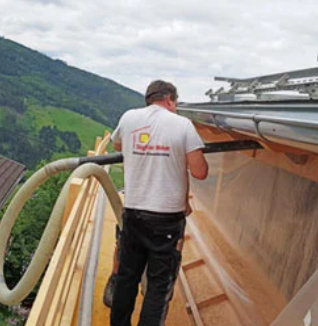
Blown insulation made from wheat straw can be installed on site using conventional blowing machines and is suitable for new builds, extensions and retrofit insulation in existing buildings. In façade applications, wood fibre render carrier boards are usually installed on the outer wall, and the resulting cavities are then professionally filled with insulation.
There is also the option of filling wall, ceiling or roof elements with SonnenKlee organic blown straw during off-site prefabrication in a timber workshop. This enables high execution quality, short construction times and efficient integration into modern timber building systems.
On the Projects page, you can explore different applications and construction methods using straw and gain inspiration from completed projects.
SonnenKlee blown straw insulation is generally installed directly on site using conventional blowing machines. Through hose systems and suitable blowing tools such as nozzles, lances or needles, the material is applied efficiently and evenly into the relevant insulation cavities. This method allows flexible use across different constructions and ensures reliable compaction of the insulation material.
In factory prefabrication, the straw can also be blown into horizontal wall, ceiling or roof elements using conventional technology. This makes it possible to achieve high quality standards, short on-site assembly times and precise material dosing.
Particularly innovative and high-performing is processing via a large-bale system combined with a blowing plate for prefabricated elements open on one side. This method enables economical, fast and even filling of large-format building components and is particularly suitable for serial timber construction and prefabricated systems with high efficiency requirements.
Blown straw insulation offers a very positive environmental footprint. Installation is fast, clean, seamless and almost waste-free, ensuring efficient processing and high quality.
Certified SonnenKlee straw blown insulation creates a healthy indoor climate and a high level of living comfort. As a renewable raw material, organic straw stores CO₂ and makes an important contribution to climate protection. In addition, the product is part of a circular material cycle and can be disposed of simply and cost-effectively.
Further benefits of insulating with straw can be found here.

At SonnenKlee, we are your trusted partner for the professional processing of building straw. Through our collaboration with blown insulation companies operating across Europe, we help you find a suitable installation partner in your region. Alternatively, your local timber construction company can source our blown straw insulation and process it easily using existing blowing equipment.
An overview of our cooperation partners can be found on the Partners page.
Do you have any questions?
Virko Kade will be happy to advise you personally:
daemmstoffe@sonnenklee.at